
Use Utah's Orem Voter Lookup
The official Utah Voter Search is the first stop for an Orem voter checking their own record. It is an identity-confirmation tool, not a browse-by-name directory. Every identity and residence field is required, followed by reCAPTCHA. Enter the address tied to the current registration rather than a new address that has not yet been submitted.
| Lookup label | Input style | Needed | How the form uses it |
|---|---|---|---|
| First Name | Text | Yes | Exact identity input |
| Last Name | Text | Yes | Exact identity input |
| Date of Birth | Masked date | Yes | Confirms identity; withheld from the public file |
| Street Address | Text | Yes | Registered residence address |
| City | Text | Yes | Enter Orem when that is the registered city |
| Zip | Masked ZIP | Yes | Registered residence ZIP code |
| reCAPTCHA | Verification | Yes | Blocks automated queries |
- Enter the first and last name exactly as used for registration.
- Add the birth date and complete registered Orem residence, then pass reCAPTCHA.
- Review the returned status and polling details. If there is no match, verify the address and call Utah County Elections.
A match can return current status and polling information. The production result may also label the administrative Voter ID Number. If the Orem voter registration search finds nothing, check the exact registered address and its format. Then contact Utah County Elections. A blank result is not sound proof that the person is unregistered.
The live form is shown in the official Utah voter lookup capture.
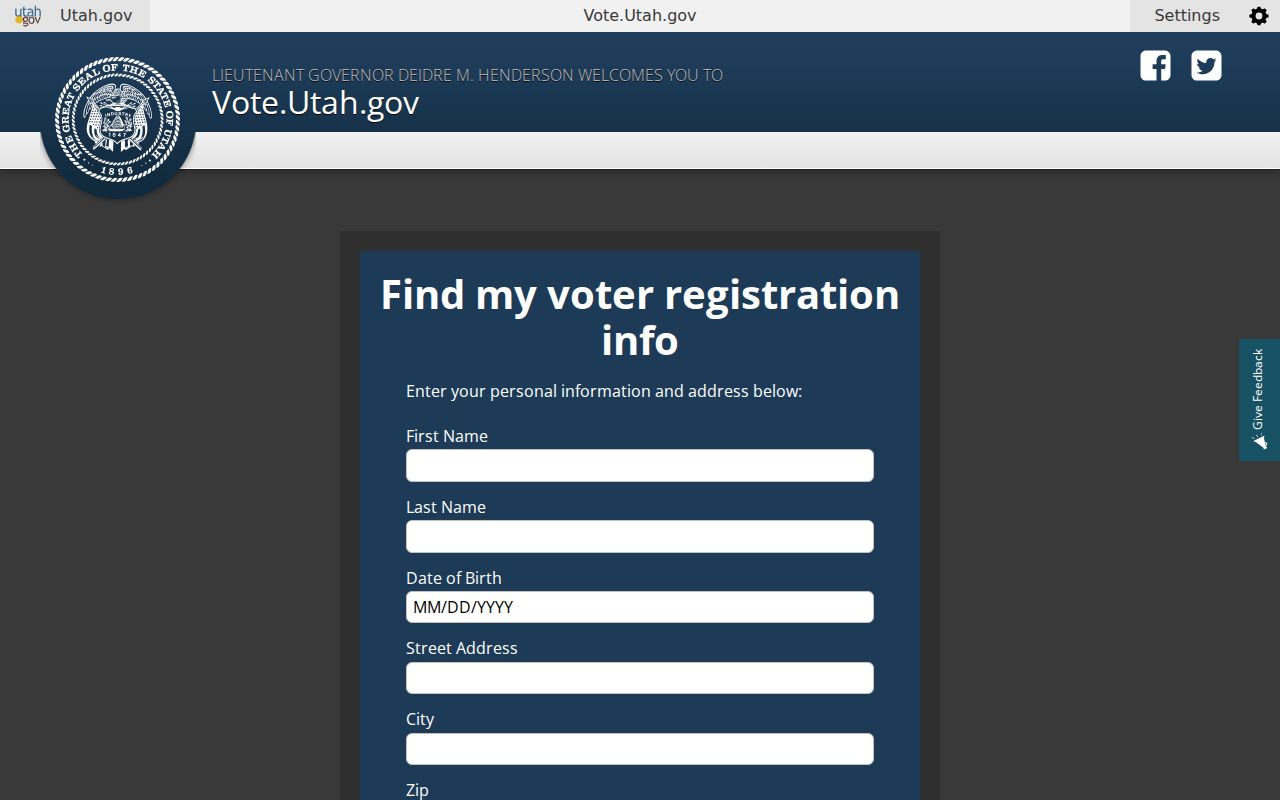
The required birth date and full residence combination explains why the portal should be used for one's own voter record rather than open-ended searches.
Read an Orem Voter Registration Match Correctly
A successful personal lookup answers a narrow election question. Status indicates how the registration is administered. Polling information directs the voter to the current voting location, while district data may reflect recent boundary changes. The Voter ID is an election-system identifier. It is not a Utah driver license or state identification number.
Residence in a voter record is the address represented on the registration. It may lag a recent move and should not be treated as independent proof that someone lives there today. If an Orem voter has moved, the right action is to update the official registration. The lookup is not a correction form.
Note: Record the lookup date because registration status, polling places, precincts, and districts can change over time.
Fields Released From Orem Voter Records
The public statewide voter file is much broader than the self-lookup result, yet it does not release every item on a registration form. Utah divides the fields into public civic data and confidential identity or contact data. For Orem entries, geography can extend from the residence and precinct to federal, state, school, county, and city council districts.
| Field group | Public voter record contents |
|---|---|
| Identity | Full legal name, voter ID, and age range |
| Address geography | Residence and unit, county, mailing address, and mailing city, unless protected |
| Districts | Precinct; congressional; Utah House and Senate; state and local school boards; county and city councils |
| Affiliation and status | Party or unaffiliated, active or inactive, and last update |
| Participation history | Elections in which the voter participated, never selections made on a ballot |
Confidential under Utah law. Full date of birth, driver or state-ID number, Social Security number, email, and phone are never public file fields. At-risk voter details are also suppressed under Utah Code §§20A-2-601 through 607 and GRAMA §§63G-2-201, -202, and -302.
At-Risk Privacy for Orem Voter Registration
Utah's at-risk classification protects eligible voters without cancelling their right to register or vote. The designation can cover victims or threatened persons, law-enforcement personnel, people protected by court orders, members of the armed forces, public figures, and qualifying household residents. The current request should be made through an election officer with documentation for the applicable category.
Once approved, identifying registration details are suppressed or anonymized in public releases, including products made for parties and candidates. Election reports may still count participation without identifying the voter. This distinction matters in Orem: privacy changes the released record, not the underlying registration.
The Utah voter privacy information explains the current classification.
Note: A qualifying household member should follow the current form and statute instead of assuming protection transfers automatically.
Utah County Handles Orem Election Requests
Orem is not the county seat. The local elections custodian is Utah County Elections at 100 E Center Street, Suite 3100, Provo, Utah 84606. The office is open weekdays from 8 a.m. to 5 p.m. Call 801-851-VOTE or email elections@utahcounty.gov for help with a personal no-match, an Orem-specific data need, or a request limited to a county, city, or district.
The state sells only the statewide file. Utah County can quote a local subset, but the research found no published county fee or format. State the geography, needed fields, current-as-of date, and preferred format. Do not assume the statewide price or an election-report price applies to the county product.
The office channel appears in the Utah County Elections contact page capture.
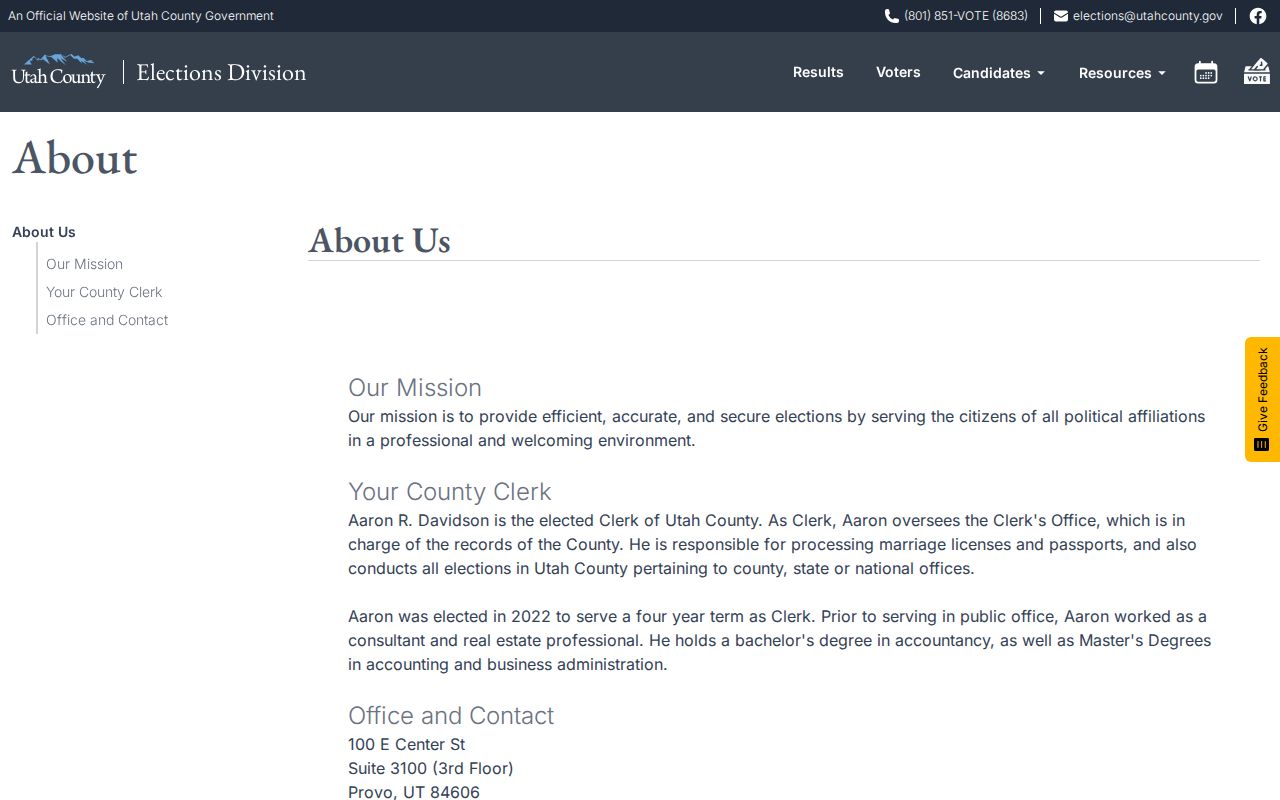
The county route is also the best fallback when exact registration inputs do not produce a self-lookup match.
Order the Utah File Containing Orem Voters
The Lieutenant Governor's election-data service offers the statewide public voter file. Orem voter records appear within that statewide product. It is a tab-delimited download of about 150 MB, delivered by an emailed link within one business day. The one-time price is $1,050, with no refund, subscription, or free update. The current process routes orders through the state's elections request service.
- Open the official election-data page and select the statewide voter registration database rather than a campaign-period report.
- Review the public field inventory, delivery terms, price, and the state's current request route before submitting payment.
- Download the tab-delimited file from the emailed link and preserve its date. Use a database-capable program because a spreadsheet may omit rows.
The ordering interface and product details are visible on the official Utah voter-data page.
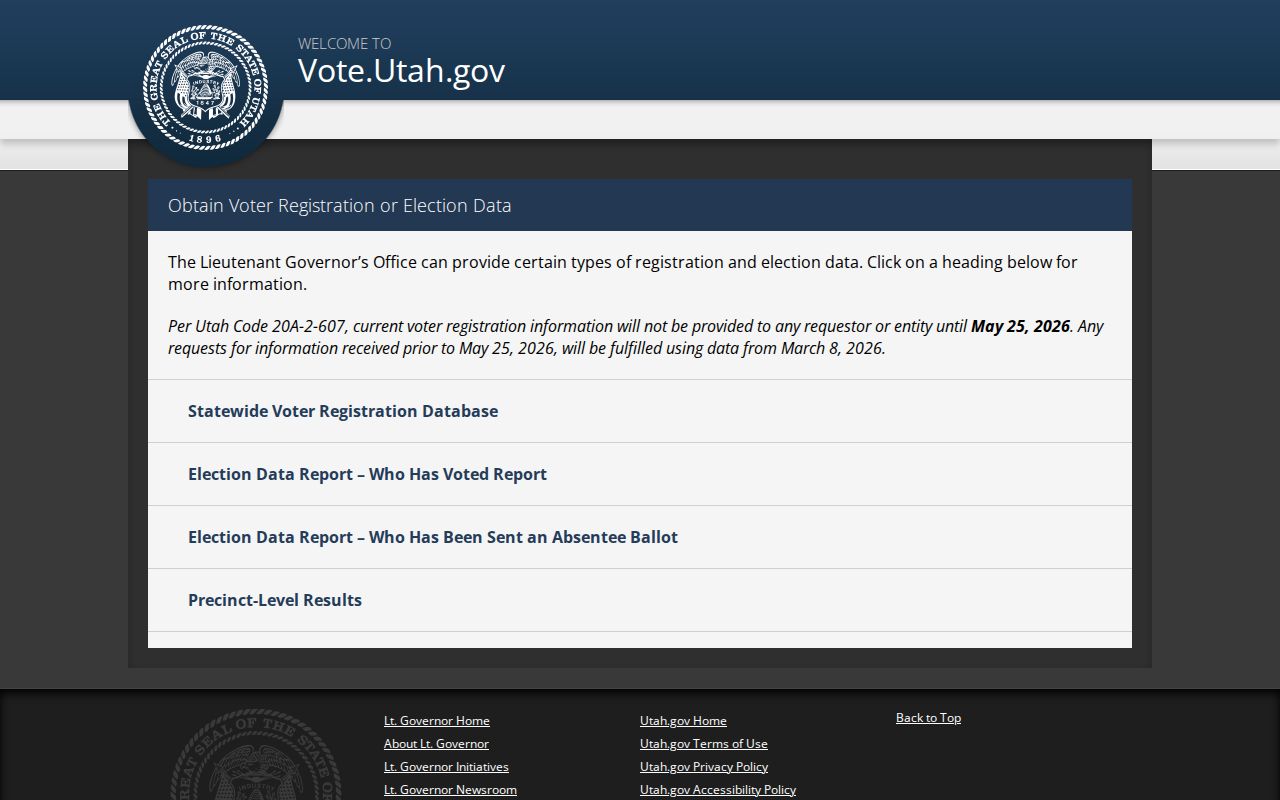
The file is unnecessary for an Orem resident who only wants to confirm personal status. The free identity-gated lookup is built for that task.
Vote History Never Reveals Orem Ballots
Participation history records that a voter took part in a named election. It never shows how the person voted. Party affiliation or an unaffiliated label is also a registration field, not proof of voting behavior. These limits apply to the statewide voter rolls and to the separate Who Has Voted reports.
Utah sells Who Has Voted and Who Has Been Sent Absentee Ballot reports for $35 per election. They cover regular even-year primary and general elections and are delivered daily from 21 days before the election through the day before it. Fields can include voter ID, legal name, residence, county, precinct or congressional district, voting method, ballot order or processing dates, and party. Precinct results are free by request.
Use voter data lawfully. Public access does not authorize stalking, harassment, impersonation, or account access. Utah Code §§76-5-106.5 and 76-9-201 address stalking and electronic communication harassment.
Active and Inactive Orem Voter Records
Active, inactive, and removed are not interchangeable. After a voter has no federal-cycle participation or record update, the maintenance process uses confirmation. The registration can become inactive. Continued inactivity through another federal election cycle can later lead to removal under the National Voter Registration Act sequence.
Utah publishes monthly confirmation and removal files for two years with private data redacted. Removal-reason detail begins with November 2025 data. The statewide count dated July 20, 2026 lists 1,778,184 active records and 310,424 inactive records, for 2,088,612 total. Those are statewide totals, not Orem registration statistics.
Status is an election-administration label. It does not certify current residence, civic participation outside elections, or why a person did not vote.
Note: Never describe an inactive Orem registration as cancelled unless the official record and maintenance stage support that term.
Historical Orem Voter Rolls Need Archives
Current portals do not establish the full history of Orem voter registration. Poll books and registration registers may survive through Utah County or the Utah State Archives, but exact Orem and Utah County coverage years were not verified. Start with the election year and precinct, then ask the Utah County Clerk whether the record remains local or has transferred.
The Utah State Archives city and county records guide is the next channel. Give the old address, election date, precinct if known, and the record type. Researchers should expect privacy and retention limits around voter material, especially where a series includes data that was not public at creation.
Historical poll books can show participation or precinct context. Like current vote history, they do not disclose ballot choices. Cite the archive series and page rather than turning a historical entry into a claim about how an Orem resident voted.
No Match in Orem Voter Lookup
A no-match calls for a short, careful fallback chain. First, confirm that each of the six identity and residence fields matches the current registration. Address formatting and a recent move can matter. Do not keep probing another person's details. Contact Utah County Elections with one's own information and ask the office to confirm the correct update or registration route.
If safety is the concern, ask about at-risk designation and how released information will be suppressed. A public bulk file will not solve a self-service lookup problem, and it excludes confidential full birth date, driver or state-ID number, Social Security number, email, and phone. The official voter registration channels preserve those boundaries while giving an Orem voter a clear path to correct or confirm a record.
A registration or update follows a different channel. Utah's paper form collects eligibility statements, name, residence and mailing addresses, birth date, party choice, prior registration, signature, and certain identity or contact details. Online updates use state identity checks. Sensitive fields do not become public merely because the voter supplies them on a form.