
Orem Directory Sources at a Glance
Orem people directories answer different questions because their keepers record different relationships. A city number reaches a department. A campus profile identifies a work role. County land tools connect a name with a parcel, while professional and business indexes connect a person with a license or filing. Cemetery and archive sources reach much further into the past. Access also varies from a free name search to an office call or a library visit.
| Directory | People or roles listed | Official keeper | Best access route |
|---|---|---|---|
| Orem department directory | City departments and service lines | Orem City | Free static web list |
| UVU directory | Employee groups and departments | Utah Valley University | Free name or department search |
| School staff portal | District and school personnel | Current local school district | Dynamic web directory |
| Land Records and Parcel Map | Owners and care-of recipients | Utah County | Free owner, address, or serial search |
| DOPL Licensee Lookup | Utah-licensed professionals | Utah DOPL | Free name, profession, or license search |
| Orem Cemetery database | People buried in mapped lots | Orem City | Free alphabetical database |
| Historical directories | Past occupants and households | Library and archives | Catalog, reference desk, or archival series |
Begin with the directory that reflects the relationship being tested. For a campus contact, use UVU. For a person tied to real estate, use Utah County. For an older Orem name, the cemetery, library, recorder books, and archives work better together than a modern phone list. Public voter data and custody lists have tighter purposes and limits, so they should not be treated like open address books.
Orem Government Directory Limits
The official Orem city directory is a department phone list, not a staff-name search. It routes callers to Building, Business Licensing, City Hall, Cemetery, City Council, Animal Control, and other services. The Help Center at 801-229-7000 is the best fallback when the right department is unclear. Orem also does not have a verified official personal-name portal for all city workers, and the research found no unified Utah County or state employee directory that should be substituted for one.
The official directory page shows why the distinction matters:
View Orem's department contacts at the city source.
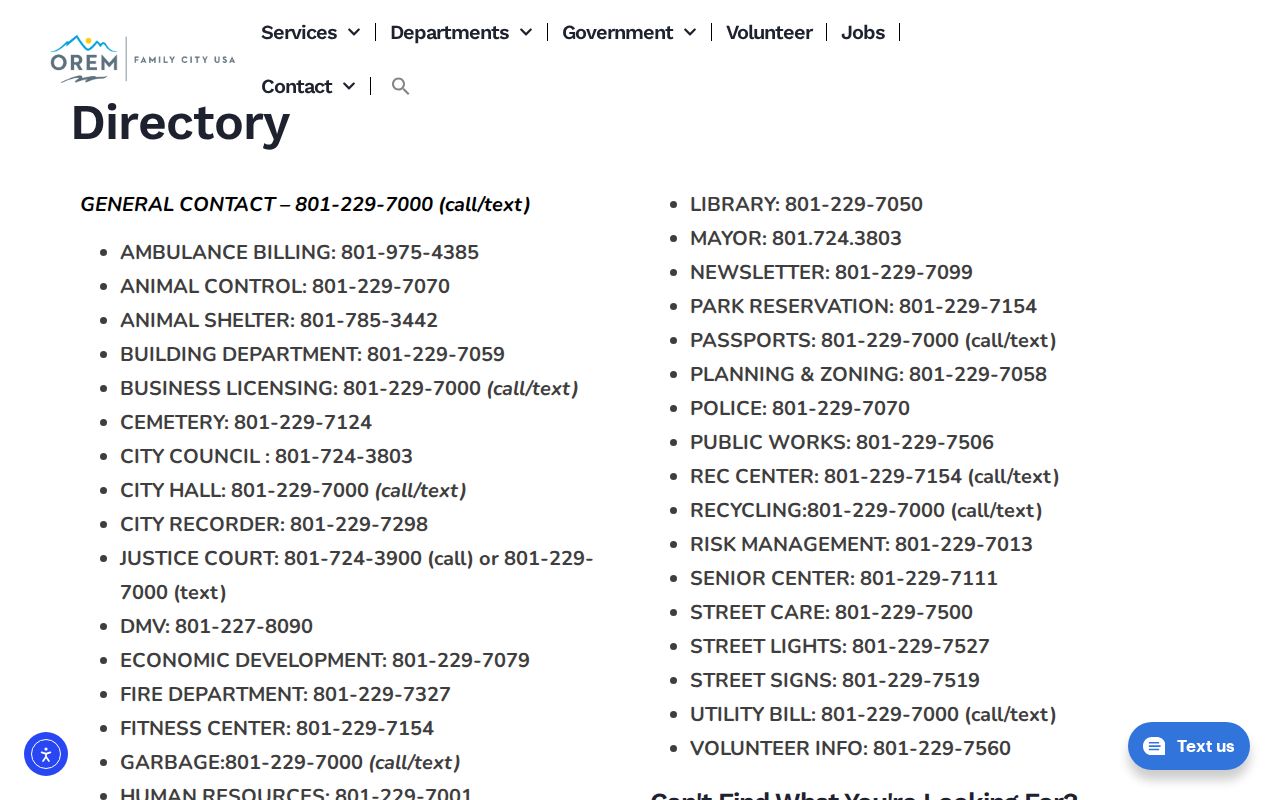
The screenshot presents offices and routing numbers rather than profiles for individual employees. If a listed line cannot identify the correct custodian, contact the Help Center, then use the city's records-request channel for an existing roster or city record with a precise department, name, record type, and date range.
That fallback does not require the city to research a question or create a new list. The request must describe an existing record. Judicial files go to the Justice Court clerk, while police material follows the police records channel and may have private or protected portions. Detailed access rules belong in the Orem public records resource.
Note: A missing personal name in Orem's directory means the list lacks that field, not that the person has no city role.
Orem Campus and School Directories
The Utah Valley University directory is Orem's strongest public institutional name directory. Its single search box accepts a name or department. Results divide into full-time, part-time, student employee, and department groups. A name can lead to a profile, title, department, phone, and mailstop. Direct email is shielded behind a Send Message function, and confidential flags can keep some people out of results. Absence is not proof that a person has no UVU connection.
| UVU search or result field | How the directory uses it |
|---|---|
| Search by Name or Department | One text field for either a person or organizational unit |
| Employee group | Separates full-time, part-time, and student employees |
| Name and profile | Links a listed person to available professional details |
| Title and department | Explains the current institutional role |
| Phone and mailstop | Provides work contact or internal delivery information when published |
| Send Message | Allows contact without exposing a direct email address |
A sampled UVU result shows how much a public profile may contain without exposing direct email:
| Sample field | Published UVU detail |
|---|---|
| Name and profile | Randall Smith, linked to a profile page |
| Position | Adjunct Instructor, Technology Management |
| Work contact | Published phone and mailstop 209 |
| Profile detail | Biography, experience, education, and certifications |
| Email treatment | Shielded behind Send a message |
Those fields describe an institutional role at the time of capture. They do not establish a home address or guarantee that every past or present worker appears.
The Alpine school staff portal offers a current dynamic directory, but Orem-area district reorganization makes coverage time-sensitive.
The captured portal is useful for present contacts, yet older personnel may belong to a legacy district or school record. Check the person's school and current district first. For past staff, ask the relevant district for archived rosters and use school yearbooks through library or school collections.
Orem Property Owner Directories
Utah County's Land Records system works as an owner directory for Orem parcels. Search by owner name, property address, or serial number. An owner result can show a name, serial, tax area, years valid, and property address. The Parcel Map adds partial-owner searching, address autocomplete, flexible serial formats, historic system views, and fields for the owner, care-of recipient, situs address, owner mailing address, subdivision, lot, and vesting document.
These labels must stay separate. The situs address is the land's physical location. The mailing address is where the tax notice goes. A care-of name may identify a fiduciary, manager, or other recipient. None proves that the named owner lives on the parcel. This Orem directory quirk can still help distinguish two people with the same name, especially when a parcel serial or deed number matches another source.
Owner is not occupant. Confirm legal title in the Recorder's instrument, then use a dated directory, census, or other source when occupancy is the real question.
For older ownership, the Utah County Recorder's official land series starts in 1870, but the computerized party-name index begins in January 1978. Search the free current index first. A pre-1978 name requires the office's handwritten alphabetical books, while legal description and abstract searches can bridge address changes. Recorder staff can help locate a known index or document at the Provo office, by phone, email, or mail, but they do not perform title searches.
Orem License and Business Directories
The official DOPL Licensee Lookup searches by Name and Profession or by License Number. Name matching can begin with the entered text or contain it, and board checkboxes narrow a common name to a field. A typical result may show the licensee, profession or type, license number, status, issue and expiration dates, and a public discipline link. Keep the page's displayed currency date with any claim because professional status can change.
Orem's municipal licensing records add a local directory of firms and trade categories. Its controls include Business Type, a Begins With or Contains name match, partial Business Name, beginning and ending dates, and Nature of Business. The preset beginning date is a search control, not verified proof that every city license since that date is complete. When the result lacks a principal, call Business Licensing or request the specific license record.
Utah state entity filings can then identify legal entities, registered agents, officers or principals, and addresses. A registered agent is a service contact, not automatically the owner, and an entity address may be a mail or agent location. DOPL verifies the regulated credential, the state entity filing identifies the legal organization, and Orem's license shows local authorization. Each directory proves a different point.
Note: Match a common name with profession, license number, firm, or location before treating a directory result as the same person.
Orem Civic Status Directories
Some official people directories have a narrow civic purpose. Utah's voter self-lookup requires first name, last name, birth date, street address, city, ZIP code, and verification. It confirms the user's status and polling information; it is not an open surname directory. The public voter file has defined public fields and suppresses confidential identifiers and at-risk voter details. County or city subsets go through Utah County Elections, not a general people-search form.
Custody directories also require care. The Utah County Sheriff Inmate Search accepts a name or arrest date and carries a stated posting delay.
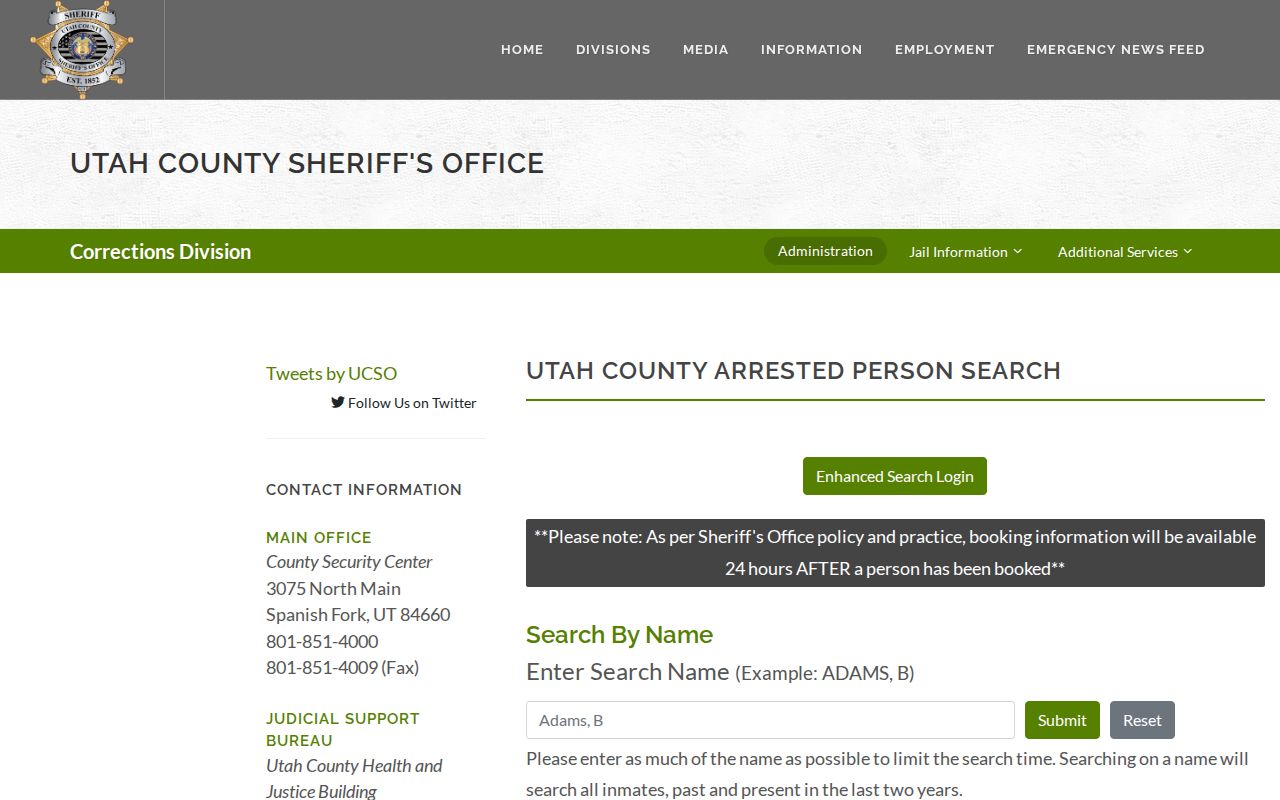
The screenshot represents a booking lookup, not a court finding. A booking can precede adjudication, and charge, bond, or release codes can change. The Utah Department of Corrections search covers current prison or community supervision and is not the county jail roster. Use the booking or offender number, agency, and date to separate people who share a name.
Map Orem Cemetery Directory Entries
The official Orem Cemetery database is one of the city's most useful historical people directories. Its alphabetical entries may contain first and last name, middle name or initial, sex, birth date, death date, and cemetery lot. A lot link opens a section map, turning a name result into a physical place. Funeral information can add a recent lead, while the cemetery office at 801-229-7124 handles corrections and missing burials.
A cemetery directory entry is not a certified death record. The database states that it uses best efforts, and a blank middle name or date does not mean no burial occurred. Pair the entry with an obituary, probate order, or an eligible death certificate. For aged records, Utah makes death records public after 50 years, and the State Archives becomes the better confirmation route as records transfer.
Lot ownership and interment are also different facts. The mapped lot can connect relatives or nearby burials, but only cemetery staff can settle plot deed and administration questions. That distinction makes the Orem list valuable for family research without asking it to prove more than it records.
Orem Library Directory Research
The Orem Public Library is the local fallback when a directory is not fully online. Search its catalog by surname, exact title, or subject, then add terms such as Orem, Provo Bench, directory, telephone, yearbook, obituary, or newspaper. Reference staff can check closed stacks, microfilm, and licensed in-library databases that a public catalog view may not expose.
Orem Public Library
Catalog: Item-level title, author, and subject discovery
Reference help: Closed stacks, microfilm, and in-library databases
Directory years: Confirm exact Orem holdings with staff
Posted hours: Monday through Friday, 9 a.m. to 9 p.m.
The library's official site is the lead-in to those catalog and reference channels:
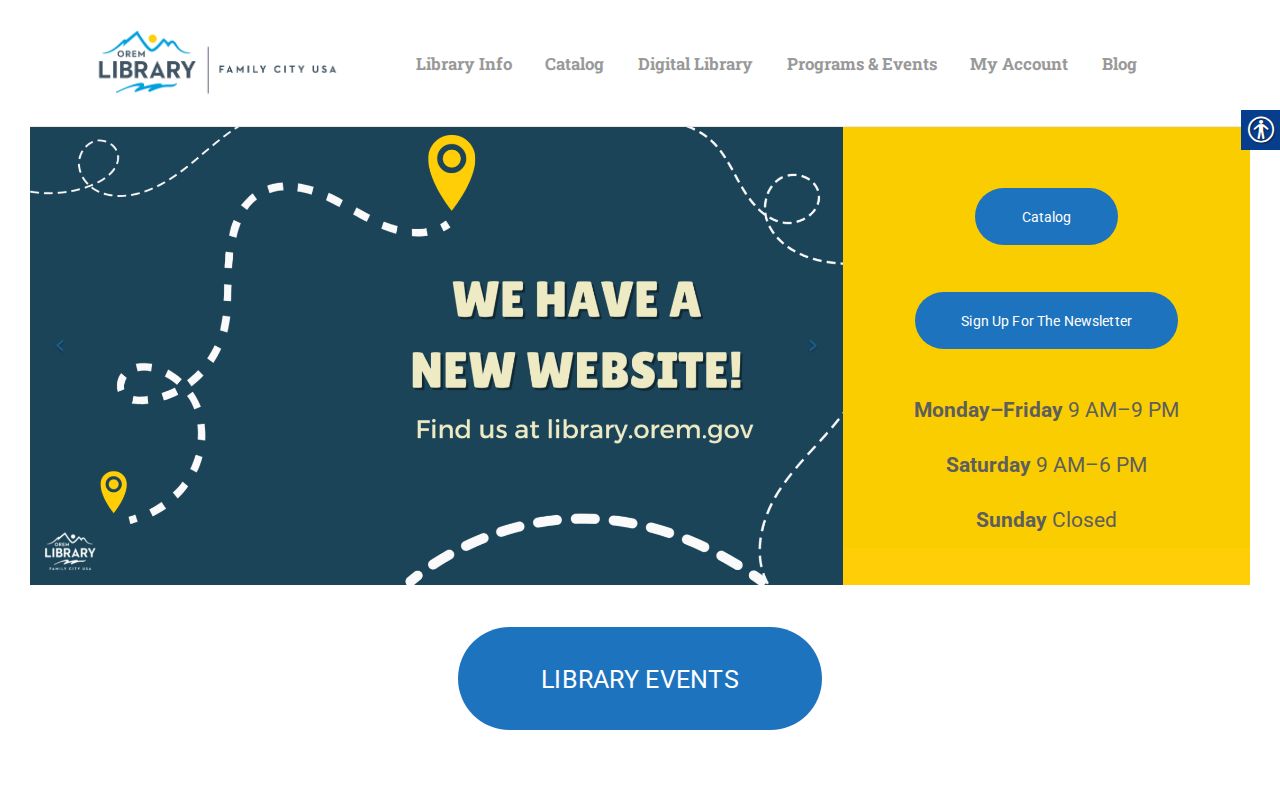
The capture does not document a complete run of Polk, telephone, or reverse directories. Exact Orem years and obituary coverage were not published in the official material reviewed, so verify holdings with the reference desk before planning a visit or citing a gap. This is more reliable than borrowing Provo or Salt Lake City coverage and labeling it Orem.
Phone books and reverse directories are dated evidence. A conventional directory moves from a name to an address or phone. A reverse, or criss-cross, directory starts with an address or telephone number and points toward an occupant. Pair the target year with county deeds and census records because a directory lists a contact or occupant, not necessarily the property owner.
Provo Bench Names in Orem Directories
Older Orem directory searches may fail because the place name changed. Nineteenth-century settlers developed orchards on Provo Bench before Orem took its railroad-linked name. County land descriptions, church sources, family papers, and early local references may therefore use Provo Bench rather than Orem. Directional grid notation, subdivisions, lots, and irrigation or ditch geography can outlast a street label and keep the same household traceable.
For an old address, normalize the north, south, east, or west direction first. Use the current parcel map to obtain the serial, subdivision, lot, and legal description. Follow the deed abstract through party names, then ask the library for a reverse directory, phone book, yearbook, obituary, or newspaper near the same year. The 1950 census is the latest public decennial census as of 2026 and can supply household ties when its place and boundary fit.
This geography explains why no-match results need a fallback chain. Try the former place term, a surname variant, the parcel's legal identity, handwritten recorder books, library reference help, and archival series. A failed modern directory query records only what that tool found on that date.
Historical Orem People Directories
Historical Orem people directories extend beyond phone books. The city cemetery database preserves names, dates, and lots. School yearbooks can place a student or staff member in an institution. Orem veteran narratives assembled by Don Norton and preserved through UVU add named life stories from World War II and later wars. County marriage applications, probate roles, recorder indexes, and aged vital records can connect relatives when a simple list cannot.
- City directory
- A dated name-to-address listing that may also show an occupation or household detail.
- Reverse directory
- An address-first or phone-first list used to identify an occupant at a point in time.
- Index
- A finding aid that points to a record; it is not always the record image or certified copy.
- Public tranche
- A group of historical records opened after a statutory age threshold and transferred for archival access.
The Utah State Archives birth-index guide shows the statewide historical name and date routes available as vital records age into public access.
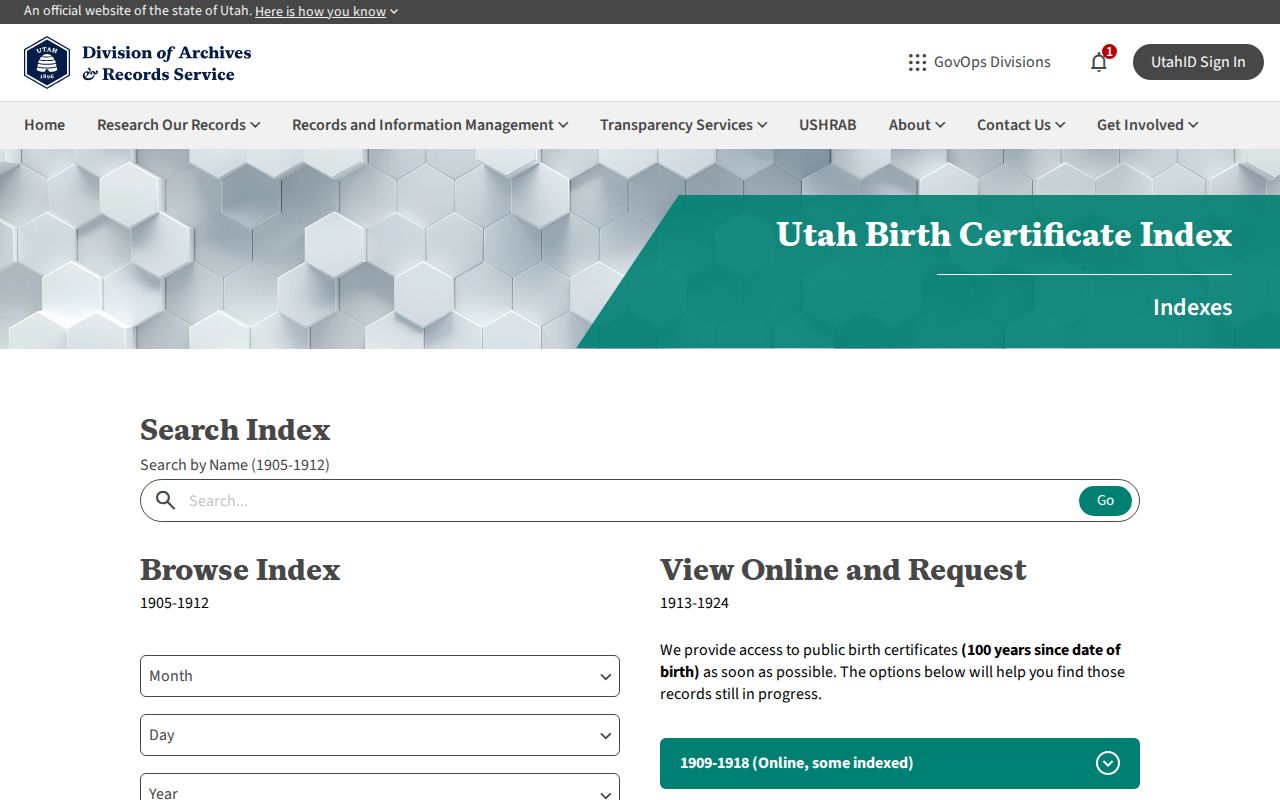
The archive view is a discovery path, not proof that every Orem birth is digitized or indexed. Utah's public thresholds are 100 years for births, 50 for deaths, and 75 for marriage, divorce, and other vital records. Search the live guide, then use the archive, issuing county, state vital office, or court according to the record's age and type.
Local directory research works best when each source keeps its own meaning. A cemetery entry supports burial, a yearbook supports school association, a deed supports title, and a probate order supports a judicial finding. Together they can restore an Orem life story without turning one partial index into a claim it cannot bear.